How to hold a pen: the dynamic tripod grip
The grip most teachers and occupational therapists start with is the dynamic tripod. Leicestershire Partnership NHS Trust's children's OT leaflet describes it plainly: the middle finger rests underneath the pencil, and the first finger and thumb sit on top (Leicestershire Partnership NHS Trust). Three fingers share the work, which is where the "tripod" name comes from.
"Dynamic" means the fingertips do the small movements that form letters, rather than the whole hand or arm. Aneurin Bevan University Health Board's OT guidance adds that in a mature tripod the ring and little fingers curl gently into the palm and the space between thumb and index finger opens into a rounder shape (Aneurin Bevan University Health Board).
Set it up in a few seconds
- Lay the pen on the table pointing toward you.
- Pinch it lightly with the pad of your thumb and the pad of your index finger.
- Let the barrel rest against the side of your middle finger, near the last knuckle.
- Slide your fingers so they sit about 1 to 3 cm (roughly half an inch to an inch) above the tip. That is the range the Leicestershire leaflet gives for keeping control of the point.
- Let the top of the pen lean back toward your shoulder. Lurie Children's Hospital describes the same thing for kids: pencil between the thumb pad and first finger, resting on the middle finger, eraser pointing toward the shoulder (Lurie Children's).
- Curl your ring and little fingers loosely and rest the side of your hand on the paper.
The grip should feel relaxed. The Leicestershire leaflet specifically says not to press hard on the pencil or on the page. If your fingertips go white, you are squeezing too much.
Does pen grip matter? Other grips that work fine
Here is the part most "correct grip" guides skip. Several well-known studies by Heidi Schwellnus and colleagues found that the tripod is not the only grip that produces good handwriting.
- In a study of 120 typically developing fourth graders filmed while writing, the researchers identified four mature grip patterns. None of them had a significant effect on legibility or speed (Schwellnus et al., American Journal of Occupational Therapy, 2012).
- A follow-up with the same 120 students used a 10-minute copy task meant to tire the hand. Legibility dropped for everyone after 10 minutes, but the dynamic tripod did no better than the other three mature grips. The authors wrote that their findings "question the practice of having students adopt the dynamic tripod pencil grasp" (Schwellnus et al., Australian Occupational Therapy Journal, 2012).
- A third study measured the force on the pen in 74 fourth graders. Grip forces were generally similar across grips, and the authors concluded that help for handwriting difficulty should focus more on speed and letter formation than on grasp pattern (Schwellnus et al., American Journal of Occupational Therapy, 2013).
The four mature grips from that research
| Grip | What it looks like |
|---|---|
| Dynamic tripod | Thumb and index finger on top, pen resting on the middle finger, fingertips doing the moving. |
| Lateral tripod | Like the tripod, but the thumb wraps across or presses against the side of the index finger instead of sitting opposite it. |
| Dynamic quadrupod | Thumb, index and middle finger on the barrel, with the pen resting on the ring finger. |
| Lateral quadrupod | The four-finger version with the thumb wrapped across the index finger. |
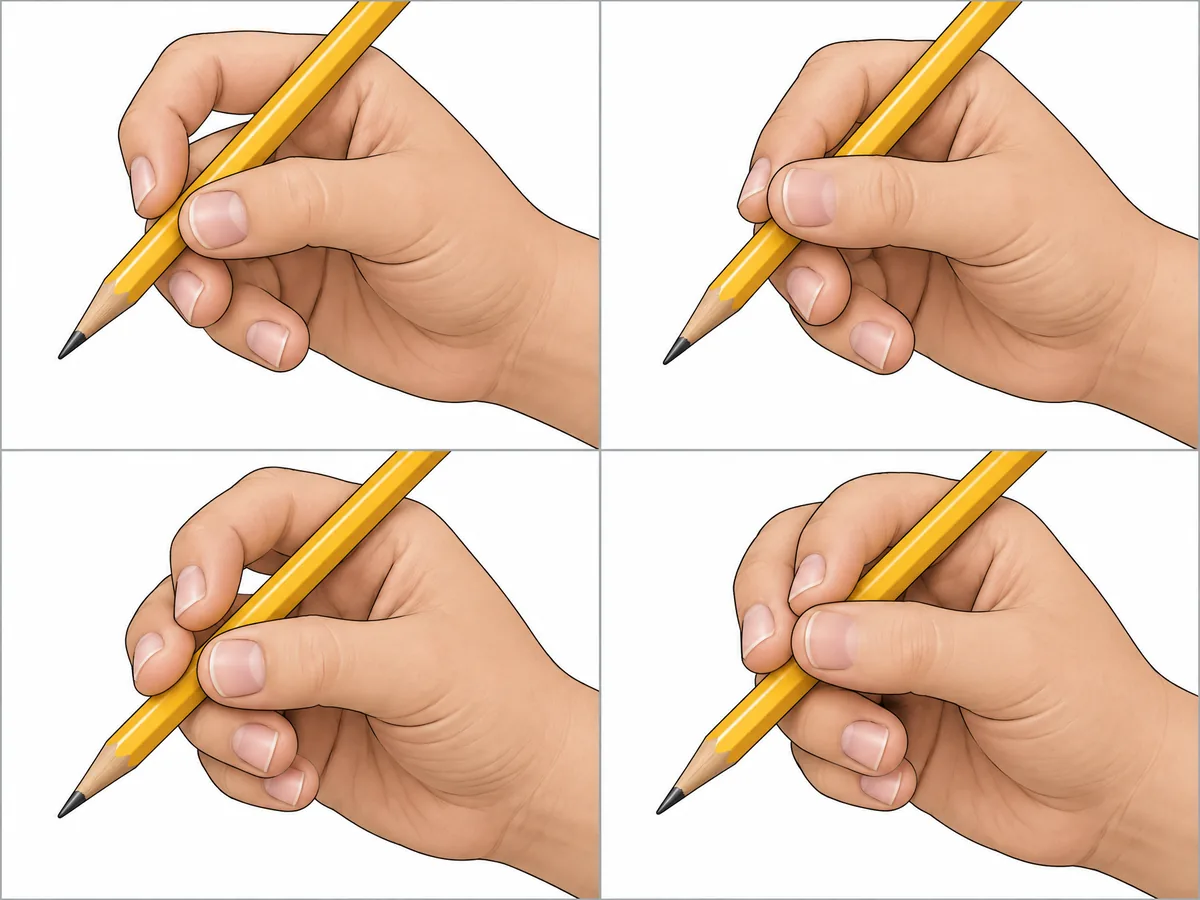
One caveat: these studies looked at fourth graders, not adults, and they measured speed and legibility rather than comfort over hours of writing. Still, the practical takeaway is reasonable for adults too. If you hold your pen in one of these patterns, your writing is readable, and your hand doesn't hurt, you probably don't need to change it. Put your effort into letter shapes and spacing instead, which is what a routine for neater handwriting covers.
Signs a grip needs changing
A grip is worth working on when it causes a problem. An unusual look on its own is no reason to change it. The Royal Children's Hospital Melbourne describes a good grip as a comfortable one that lets the hand and fingers move freely and easily. Its OT sheet lists the warning signs of a grip that isn't working: holding the pencil very tightly, pressing heavily on the page, writing slowly and with effort, and a hand that gets tired or sore (Royal Children's Hospital Melbourne).
Look for these:
- Pain or aching in the fingers, thumb or forearm during or after writing.
- Heavy pressure: deep grooves on the page, torn paper, or snapped pencil leads.
- White knuckles or fingertips from squeezing.
- Slow, effortful writing that doesn't speed up with practice.
- Whole-arm movement, where the wrist and elbow move to form each letter because the fingers are locked.
- A fisted grip in an older child. Aneurin Bevan's OT guidance places the fisted grip young children use at the very start of grip development and notes that most children master the tripod by age 6 or 7 (Aneurin Bevan University Health Board).
- Not being able to see the writing, which is common for left-handers who hook the wrist.
If none of these apply, leave the grip alone and work on the letters.
How to hold a pen without hand pain
Most writing pain comes from squeezing too hard, pressing too hard, or writing too long without a break. Pressure tends to creep up as you go. In a study of fourth graders writing for 10 minutes, grip force on the pen and pressure on the page both increased over the task, which the researchers linked to fatigue (Kushki et al., Research in Developmental Disabilities, 2011).
Loosen the grip
- Hold the pen lightly enough that someone could slide it out of your fingers without a fight.
- Move your fingers up from the tip to the 1 to 3 cm range if you are pinching right at the point.
- Write a line on purpose as lightly as you can, then a line at normal pressure. Feeling the difference helps you notice when you start pressing again.
Change the tool
The Royal Children's Hospital Melbourne suggests trying a wider pencil shaft, a pencil grip or tubing, and different pen types such as gel pens or fine liners, which need less pressure to leave a line (Royal Children's Hospital Melbourne). The Leicestershire leaflet also notes that thicker pencils are easier to hold. A smooth-flowing pen lets you relax your hand, because you no longer have to push ink out.
Fix the setup
Leicestershire Partnership NHS Trust's seating leaflet recommends sitting back in the chair with feet flat on the floor, a table that reaches to just above the elbow, the chair pulled in close, and the non-writing hand holding the paper (Leicestershire Partnership NHS Trust). It also notes that a sloped writing board can stop you leaning over the page. Tilt the paper slightly: Lurie Children's says to raise the right corner for right-handers and the left corner for left-handers.
Take short breaks
Stop every few minutes during long writing sessions, open and close your hand, and shake it out. Short practice sessions on practice sheets for adults are a good way to rebuild a lighter grip without the pressure of real note-taking.
When to see a professional
If your fingers curl, your wrist bends or your pen drops out of your hand involuntarily when you write, that is different from ordinary tiredness. The Dystonia Medical Research Foundation describes writer's cramp as a form of dystonia with symptoms such as excessive gripping of the pen, wrist flexion or extension, a raised elbow, and fingers extending so the pen falls (Dystonia Medical Research Foundation). The foundation describes it as a nervous system condition, so talk to a doctor. Persistent pain, numbness or tingling is also worth a medical check. For children, an occupational therapist can assess grip and handwriting.
How to hold a pen if you're left-handed
Left-handed writers push the pen across the page instead of pulling it, and their hand travels over what they just wrote. A few setup changes fix most of the trouble.
- Hold a little higher. Surrey County Council's guidance for left-handed writers says to hold the pen slightly further from the point than a right-hander would (Surrey County Council). This lets you see the letters as you form them.
- Tilt the paper the other way. An occupational therapist writing for the English Montreal School Board recommends tilting the paper to the right about 30 degrees for both print and cursive, and placing it in front of the left shoulder (English Montreal School Board).
- Sit on the left. Surrey's guidance suggests sitting on the left side of a right-handed writer so elbows don't bump.
- Choose a smooth pen. The same guidance advises against fountain pens unless they are made for left-handers, and suggests a smooth pointed pen such as a ballpoint for writers who hook the wrist.
A hooked wrist is common and can be workable if it is comfortable and legible. Paper tilt and a higher grip often remove the reason for it. Our grip tips for left-handed writers cover the hook, seating and smudging in detail.
Helping kids build a good pencil grip
Kids don't arrive at the tripod in one step. Aneurin Bevan's OT guidance describes five stages, starting with the fisted grip young children often use, and says most children master the tripod by age 6 or 7 (Aneurin Bevan University Health Board). Pushing a mature grip too early rarely works, because the hand muscles and shoulder stability aren't there yet.
The same guidance suggests building those foundations through play:
- Lying on the tummy and propping on the arms to color or read.
- Push and pull games and monkey bars for shoulder stability.
- Painting on an easel to build wrist strength.
- Squeezing spray bottles or using a hole punch for hand strength.
- Threading beads, using pegs and playing with playdough for the pinch.
For school-age kids, a few low-effort tricks help. Leicestershire's leaflet suggests a thicker pencil and a sticker or mark on the pencil showing where to hold it. Short pencils (golf pencils or broken crayons) also leave little room for extra fingers, which nudges the hand toward a three-finger hold. Then give them something short and satisfying to write, like their own name on tracing worksheets.
Remember the research above: if a child's grip is one of the mature alternatives and the writing is legible and comfortable, letter formation is the better use of practice time.
Questions people ask
What is the correct way to hold a pen?
The most commonly taught grip is the dynamic tripod: thumb and index finger pinch the pen, it rests on the middle finger, and you hold it about 1 to 3 cm from the tip with a relaxed hand. Other mature grips can work just as well if your writing is legible and comfortable.
Does pen grip really matter?
Less than people think. Studies of fourth graders by Schwellnus and colleagues found that four mature grips, including the dynamic tripod and quadrupod, produced similar speed and legibility. Grip matters most when it causes pain, heavy pressure or slow writing.
Why does my hand hurt when I write?
The usual causes are squeezing the pen too tightly, pressing too hard on the page, poor seating and writing for long stretches without breaks. A looser grip, a smoother or thicker pen and short breaks often help. See a doctor if pain persists or your fingers move involuntarily.
How should a left-handed person hold a pen?
Hold the pen slightly further from the point than a right-hander would, tilt the paper to the right, and keep the paper in front of the left shoulder so you can see your writing. A smooth pen such as a ballpoint reduces smudging.
At what age should a child use a tripod grip?
Occupational therapy guidance from Aneurin Bevan University Health Board says most children master the tripod grip by age 6 or 7, after moving through earlier stages that begin with a fisted grip.
Can adults change their pen grip?
Yes, though it takes regular short practice because an old grip is a strong habit. Start with slow, light writing on practice sheets for a few minutes a day, and only change your grip if the current one causes pain or illegible writing.
Sources
- Effect of pencil grasp on the speed and legibility of handwriting in children, American Journal of Occupational Therapy (Schwellnus et al., 2012)
- Effect of pencil grasp on the speed and legibility of handwriting after a 10-minute copy task in Grade 4 children, Australian Occupational Therapy Journal (Schwellnus et al., 2012)
- Writing forces associated with four pencil grasp patterns in grade 4 children, American Journal of Occupational Therapy (Schwellnus et al., 2013)
- Changes in kinetics and kinematics of handwriting during a prolonged writing task in children with and without dysgraphia, Research in Developmental Disabilities (Kushki et al., 2011)
- Help with handwriting: pencil grips, Leicestershire Partnership NHS Trust
- Let me: sit ready for handwriting, Leicestershire Partnership NHS Trust
- Development of a tripod pencil grip, Aneurin Bevan University Health Board, Children's Occupational Therapy
- Pencil Pressure (Info Sheet I), Royal Children's Hospital Melbourne, Occupational Therapy
- Occupational Therapy Tips for Handwriting, Ann & Robert H. Lurie Children's Hospital of Chicago
- Handy Tips for Left-Handed Students, English Montreal School Board
- Helping left-handed writers, Surrey County Council
- Hand Dystonia, Dystonia Medical Research Foundation